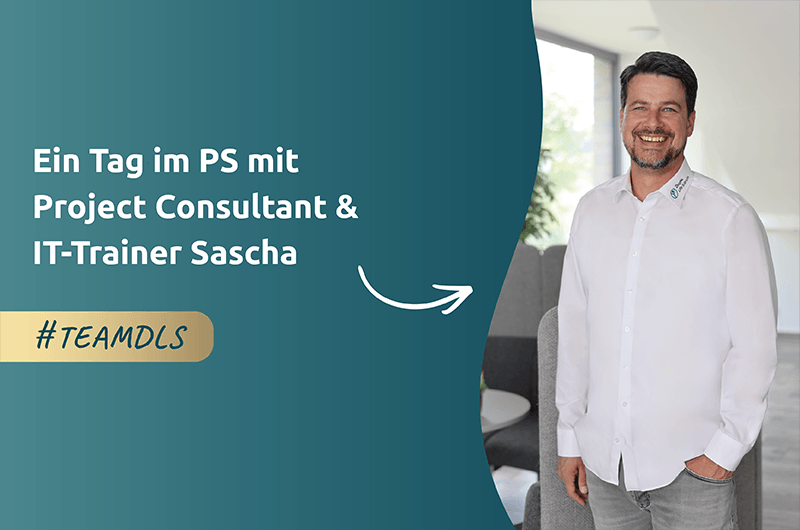
A day in Professional Services with Project Consultant & IT Trainer Sascha
What does the day-to-day work of a Project Consultant and IT Trainer at Digital Life Sciences look like? Get an insight into Sascha’s daily work and his role as a Project Consultant and IT Trainer in the Professional Services team!
Follow Sascha through a typical workday: from project work in the ECM (Enterprise Content Management) and QMS (Quality Management System) environment to hands-on customer workshops and online training sessions at the DLS Academy. Learn about the tasks he performs in customer projects, how projects are structured and implemented in compliance with regulations, and the importance of teamwork, a sound understanding of processes, and regulatory expertise for the successful implementation of software solutions in the life sciences environment.
Brief introduction of Sascha

Sascha has been a valued member of the Professional Services team at Digital Life Sciences since 2018. Thanks to his extensive expertise in ECM and QMS customer projects, particularly eDMS and eQMS solutions, he is the main point of contact for many clients.
In his role as Project Consultant, he analyses customer requirements, advises on the creation of functional and technical concepts, and brings his in-depth understanding of processes to bear in process consulting. In addition to his project work, Sascha is responsible for designing and conducting online training within the DLS Academy. In addition, he conducts customer workshops in which he conveys complex topics in a practical, structured, and easy-to-understand way.
One of his key strengths is his ability to quickly adapt to new processes, structure complex requirements clearly, and support clients throughout the entire project lifecycle—from the concept phase and go-live to ongoing operations.
He works in the office two to three days a week. His dog Käthe is also a welcome companion, contributing to a pleasant working atmosphere. After work, he switches from the role of Project Consultant to that of a dedicated family father. He finds the balance to his day-to-day project work by mountain biking in nature.


Interview – Practical insights into the ECM/QMS environment
How did you come to Digital Life Sciences (DLS)?
After twelve years at the former parent company, d.velop AG, the opportunity arose for me to join DLS and actively contribute to the company’s growth.
What is your position at Digital Life Sciences?
I am employed as a Project Consultant and IT Trainer and work in the Professional Services department.
What types of projects do you work on?
In most projects, we work in pairs: one person takes on the role of project lead, while I act as the technical point of contact. We support both new customer projects, in which an eQMS system is being introduced from scratch, and existing customer projects. The latter include, for example, system updates to new versions of the DLS system or the functional expansion of existing systems.
What training do you conduct?
Our goal is to enable customers to manage the system independently, both technically and functionally, after its implementation. We achieve this through targeted key user training within the projects, as well as training sessions for technical and functional contact persons.
How do you experience working within the team?
Our department sees itself as a true team. Everyone is always ready to support their colleagues. Presenting ourselves as a team is especially important in our interactions with clients and ensures that we are seen as accessible, dependable, and reliable.
What do you particularly enjoy about your job?
I particularly appreciate the way my job is structured within the company. Each week brings new challenges that require a high level of self-organisation. This means that there is hardly any routine, which makes the work varied and exciting. What I enjoy most about training sessions is the moment when you can see participants suddenly connect the dots and develop a clear, holistic understanding of our software.

The daily work routine of a Project Consultant and IT Trainer
Morning routine
When it comes to cooking, they say that every good dish starts with a generous piece of butter. A good cup of filter coffee is the ideal start to my working day. The upcoming tasks are determined through our resource planning, which is regularly updated during the weekly Professional Services meeting.
Morning – Project work and customer consultations
The morning is similar to the afternoon. Depending on the day, customer meetings take place either as traditional coordination calls (for example by phone) or as working sessions in which new features are configured and implemented directly in the customer’s system.
Training – Online at the DLS Academy
The training sessions I am responsible for now take place exclusively online. Each participant receives their own training environment in which the content is taught in a practical manner. The training content is delivered using structured training dcuments and reinforced through practical exercises in the training environment. The training sessions take place once per quarter in block format, as the modules are designed to build on each other.
Lunch break
My lunch break is fixed in my schedule and is the only real routine in my working day. I usually use my lunch break either for a meal in the campus cafeteria followed by a walk, a walk with my dog, or lunch with my family at home.
Afternoon – In-depth project work and implementation
The afternoon is similar to the morning in terms of content: After another coffee, I either have shorter coordination meetings or work on more extensive topics that take several hours or even several working days to complete.
End of the workday
If possible, I finish my working day at 5:00 p.m. The day usually ends with planning for the following day or providing feedback to the clients. As most of the work consists of billable services, all activities are documented within the respective customer projects.

The role of a Project Consultant (m/f/d) at a glance
- Responsibility for implementing customer projects in the ECM and QMS environment with focus on eDMS and eQMS solutions
- Analysis of customer requirements and consulting on the design of functional and technical solutions, drawing on in-depth expertise in process consulting
- Independent work within a project team as a Project Consultant
- Integration of the ECM system, d.velop documents, and dls | eQMS solutions into customers’ existing IT landscapes
- Successful implementation of defined project goals through active contribution of own ideas and a strong understanding of processes and systems
- Structured testing, documentation, and continuous optimisation of the implemented processes
- Conducting key user training prior to go-live to provide structured instruction on the central functions of the dls | eQMS solutions
- Reliable and competent support for customers as the central point of contact throughout all project phases
Sounds exciting? If you would like to contribute to customer projects in the ECM and QMS environment as part of the Professional Services team like Sascha, feel free to check our current vacancies in Professional Services and apply.
Frequently asked questions (FAQ's)
- What is the main responsibility of a Project Consultant at Digital Life Sciences?
A Project Consultant is responsible for the professional and technical implementation of customer projects in the ECM and QMS environment. The focus is on the introduction, configuration, and continuous optimisation of eDMS and eQMS solutions in compliance with regulatory requirements.
- What skills are particularly important for this role?
This role requires a deep understanding of processes, solid knowledge of regulatory requirements (e.g., GxP), technical expertise in the ECM/QMS environment, and the ability to analyse and implement complex requirements in a structured manner.
- How is the role of an IT trainer integrated into this position?
In addition to project work, the Project Consultant designs and implements structured training formats, including key user training and online training at the DLS Academy. The goal is to empower customers to independently use, manage, and further develop the systems in use.
- What types of projects are supported?
Both new customer projects involving the full implementation of an eQMS system and projects with existing customers are supported. The latter include system updates, functional enhancements, and the targeted optimisation of existing processes and solutions.
- What does a typical customer project look like?
A project involves the structured analysis of customer requirements, the development of functional and technical solution concepts, system configuration, comprehensive testing, and the provision of training. In addition, clients are supported throughout the go-live phase and during ongoing system operations.
- How is the collaboration with clients structured?
We collaborate closely with our clients through regular coordination meetings, workshops, and structured working sessions. The goal is to implement the defined project objectives in a transparent, efficient, and consistently compliant manner.
- What development opportunities does the position of Project Consultant & IT Trainer offer?
The position offers a wide range of professional and personal development opportunities. These skills are acquired in particular through participation in a wide variety of customer projects, the continuous expansion of regulatory and technical expertise, and the independent assumption of challenging tasks in complex project phases.
- How does Digital Life Sciences promote knowledge building and further development?
Knowledge building is specifically promoted through structured coordination, continuous professional exchange within the team, and active participation in the training concepts of the DLS Academy. This ensures sustainable and continuous competence development in the ECM and QMS environment.
- What added value does the role create for customers and the company?
Through the structured implementation of regulatory-compliant solutions, targeted and hands-on training for users, and the sustainable support of the systems, long-term value is created: increased process reliability, improved efficiency, and greater transparency for clients. At the same time, it contributes to the consistent implementation of Digital Life Sciences’ quality and growth strategy.